Date
From February 01, 2024 to June 30, 2024
Area / Gallery
Gallery 5
Sintonías inestables: repensando la contemporaneidad pictórica presents the most recent projects by artists Ana Segovia, Noé Martínez and Artemio, showing new artistic and discursive positions through painting.
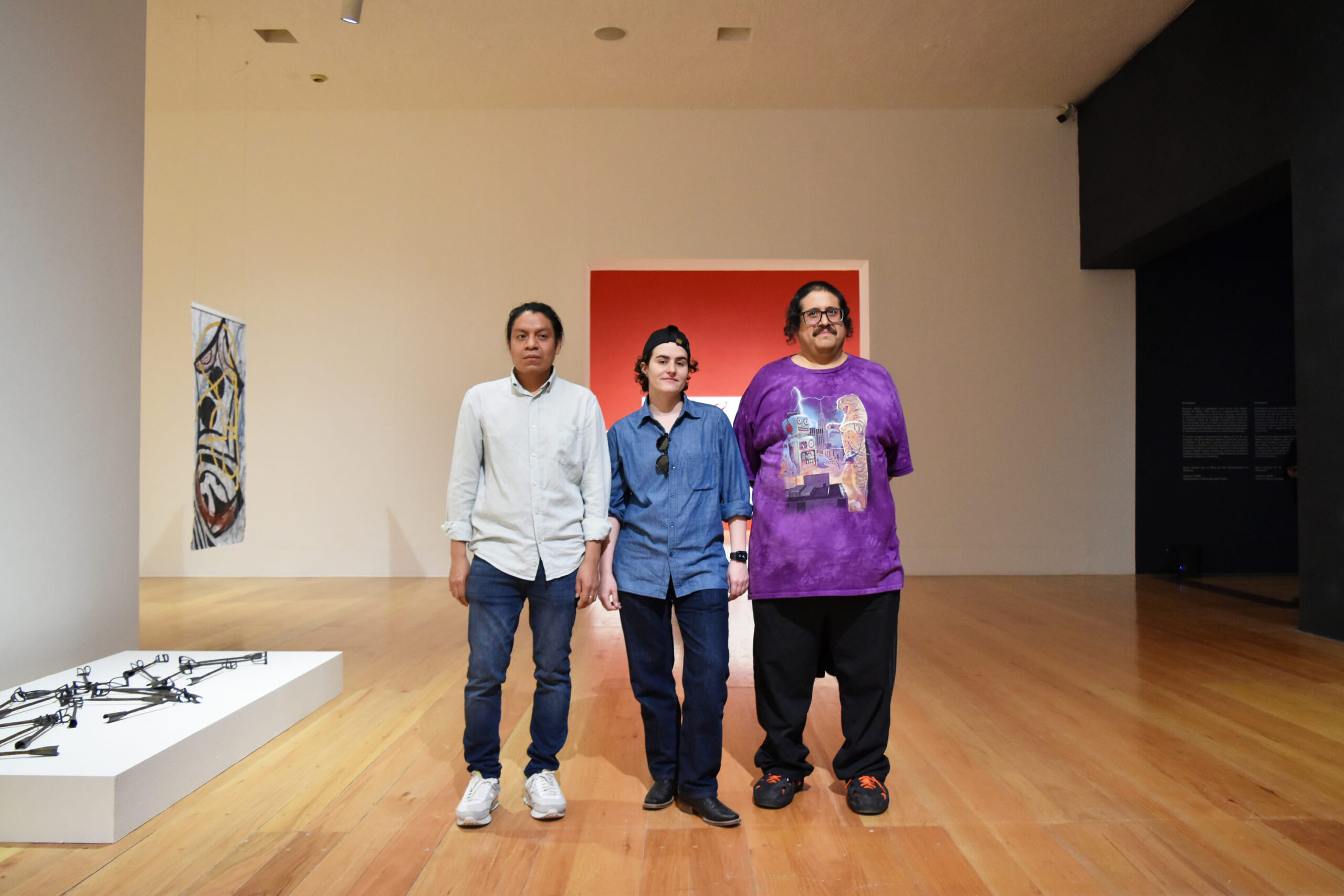
Under the curatorship of Taiyana Pimentel, with the curatorial assistance of Brenda Fernández, the exhibition analyzes current pictorial practice, proposing an approach based on three visions of different generations, but whose work reflects the challenges faced by artists in the 21st century, and the new possibilities in a medium with such an academic and historical tradition.
In terms of discourse, each of the proposals questions different issues. Ana Segovia analyzes the performativity of gender as a mise-en-scène, based on the stereotypes represented in the cinema and in public figures such as soccer players. For her part, Martínez addresses slavery during the time of the conquest, taking up pre-Hispanic and Novo-Hispanic elements, while Artemio explores the role of blood in society based on paintings by great artists in the history of universal art.
The three artists coincide in that they take up certain moments or elements of history to rethink their link with the past from their own positions; this was the curatorial vision to bring them together in this exhibition, which seeks to investigate the new narratives of pictorial representations, from a more obvious link with the history of art and film, through gesturality and pre-Columbian tradition.
The exhibition is composed of projects commissioned by MARCO to the artists, except for Sangre de Artemio, which is an institutional collaboration with the Museo Amparo, in Puebla, where it was exhibited in August 2023.
Commissioned by MARCO, Ana Segovia created two projects for this exhibition in which she continues her pictorial exploration in which she questions heteronormativity and male stereotypes, delving into pictorial languages influenced by cinema.
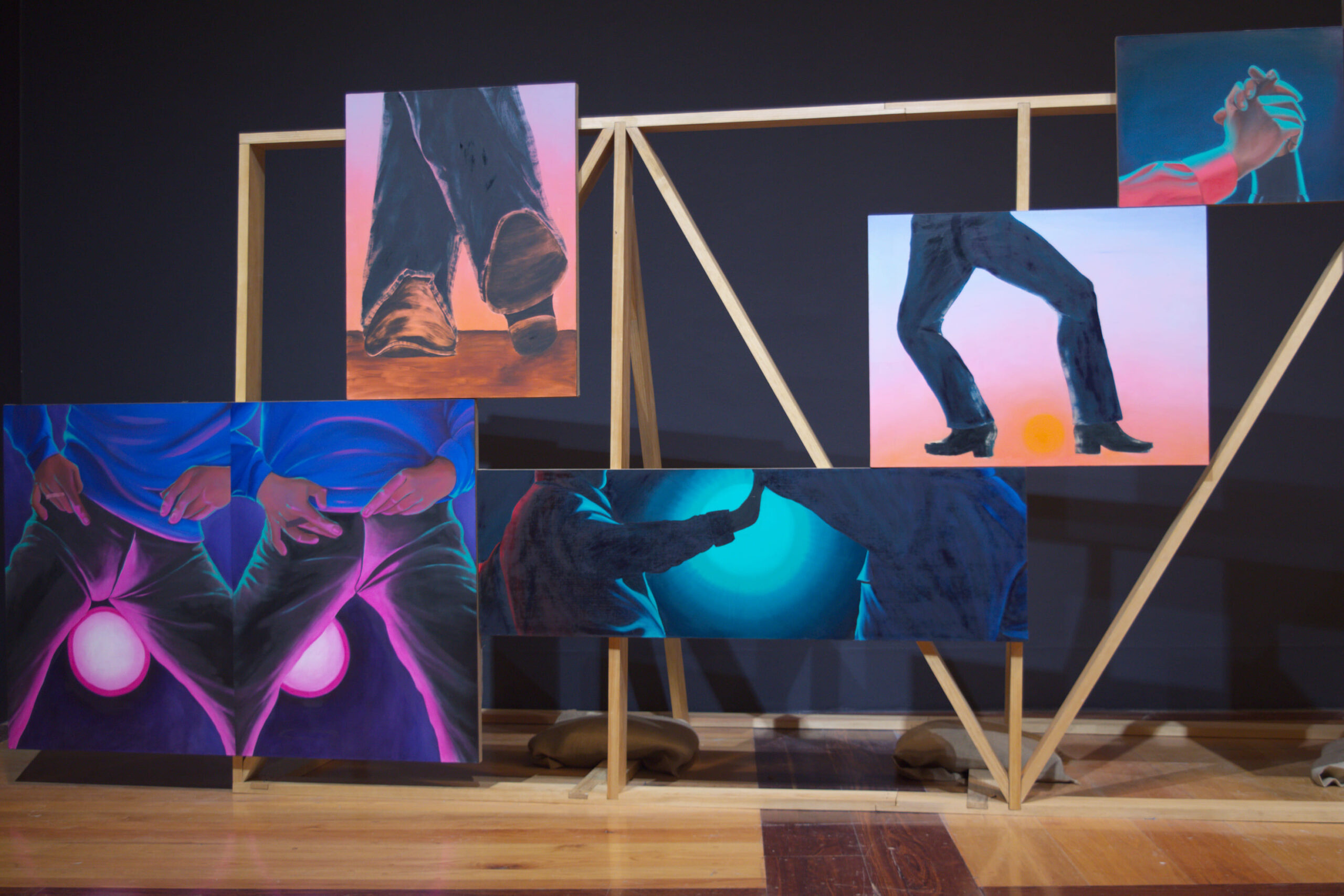
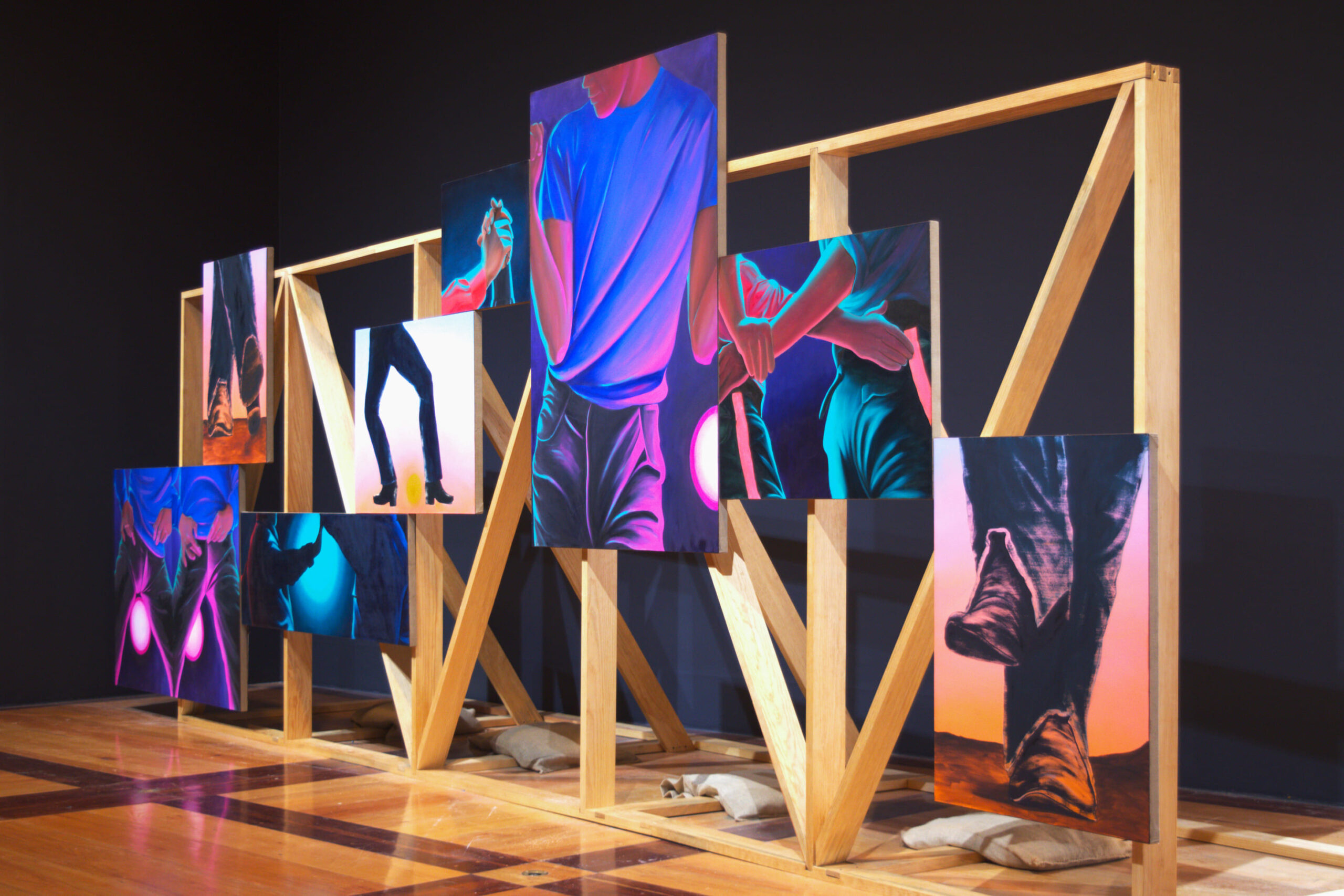
One of them is I’ve Been Meaning to Tell You (2023), a wooden structure reminiscent of panoramic advertisements that holds a series of framed paintings, which together form a kind of mural in a different format. The paintings are details of scenes that take place in a nightclub taken from Roger Alamos’ 1983 film of the same title. In a part of the plot from which Segovia extracts the scenes, the characters visit a border town where they experience nightlife. With colorful strokes and shapes that reveal the texture of the brushstroke, Segovia plays with volumes and planes to convey queer gestures, dismantling the stereotype of the northern cowboy to place our gaze on the performativity of gender expression, that daily staging of people before the world.
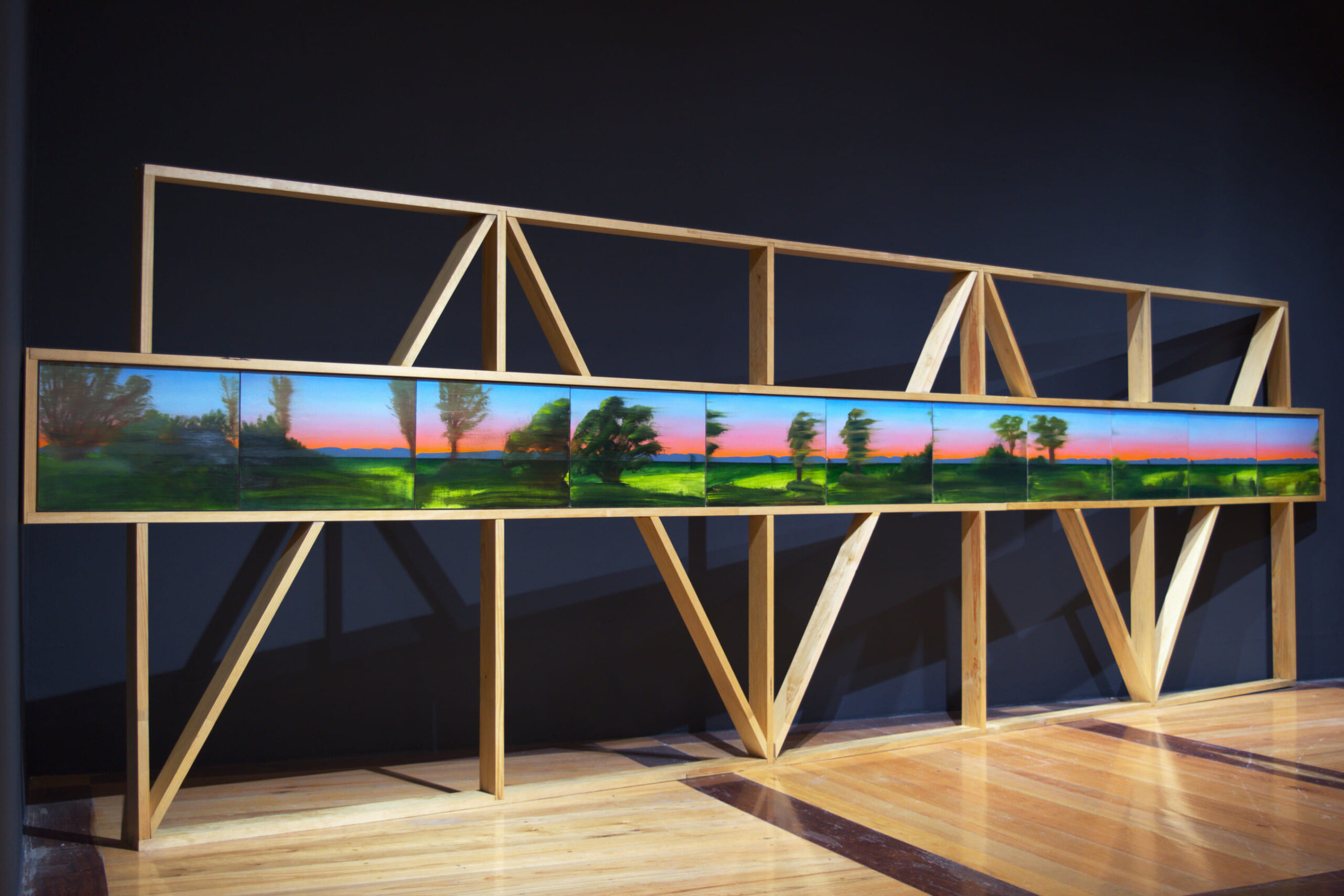
From film, Segovia presents a vision of landscape from another perspective: the foreground in movement becomes blurred while the depth is static and defined, when normally it is the foreground that should always be sharp. This is the work Un paisaje se desliza por la ventana de un tren en movimiento (2023), composed of several paintings that represent the sequence in different images.
As a result of his family history, the artist has delved into a little known part of the colonial period: the arrival of African slaves in the Huasteca Potosina, a region located in northern Mexico between San Luis Potosi, Veracruz, Hidalgo and Tamaulipas.
As a result of his family history, the artist has delved into a little-known part of the colonial period: the arrival of African slaves in the Huasteca Potosina, a region located in northern Mexico between San Luis Potosi, Veracruz, Hidalgo and Tamaulipas.
Martínez’s artistic proposal could be located in decoloniality, a current of thought that critically studies the colonizing power, proposing to reverse that hierarchy and open new perspectives from the voice and vision of communities that historically have been dominated by certain power groups. In the case of Martínez’s work, the identity of native peoples is vindicated, especially that of their ancestors.
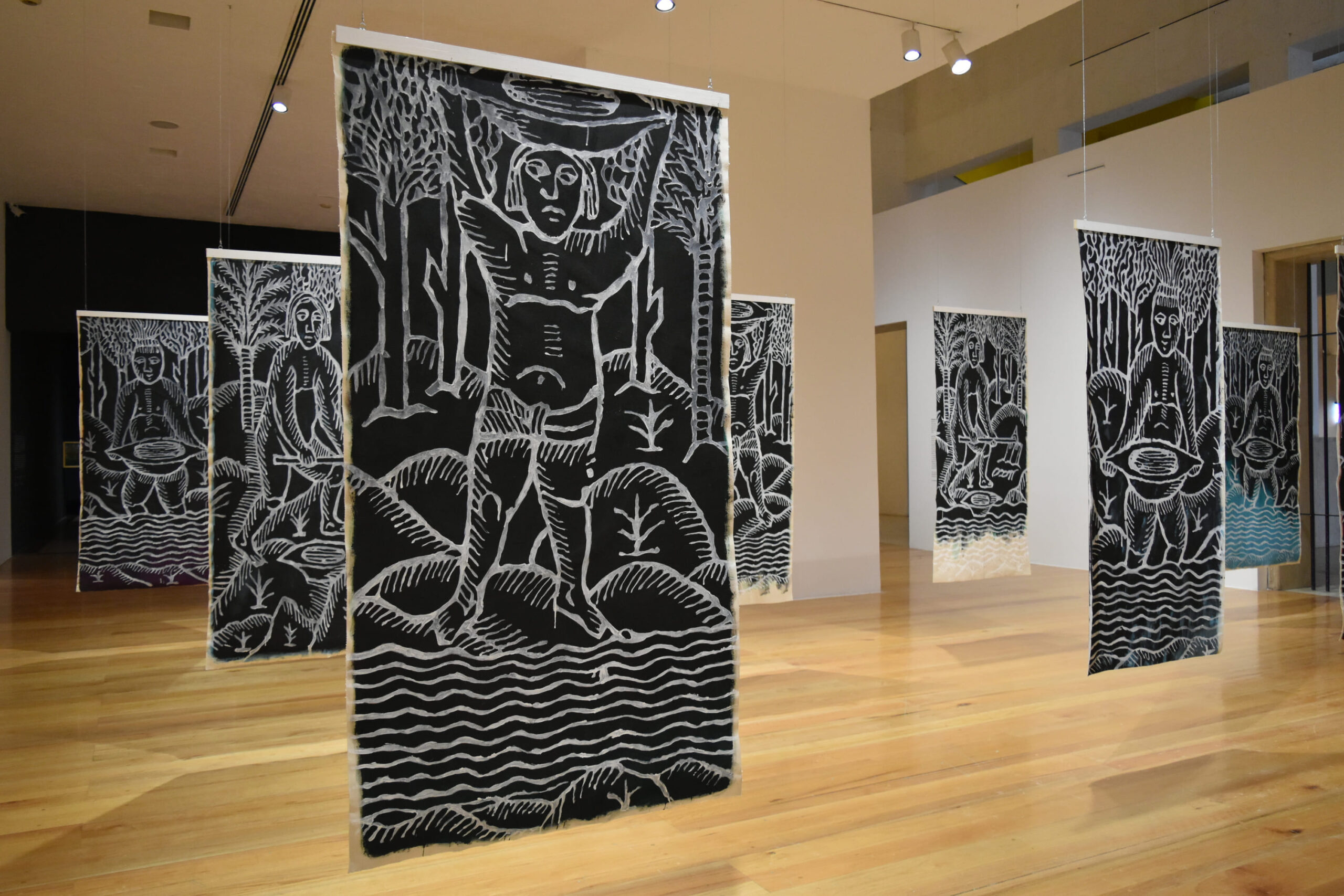
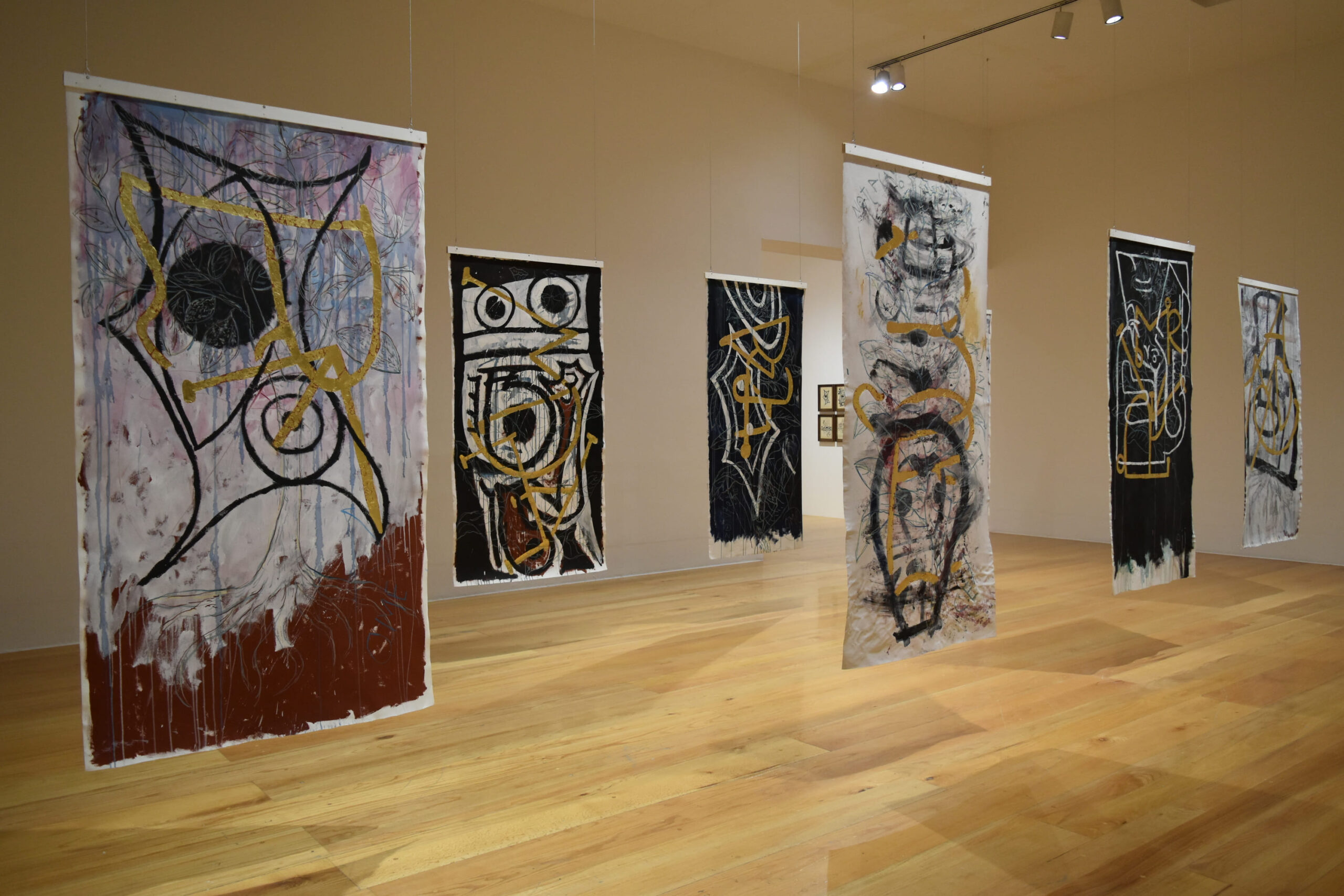
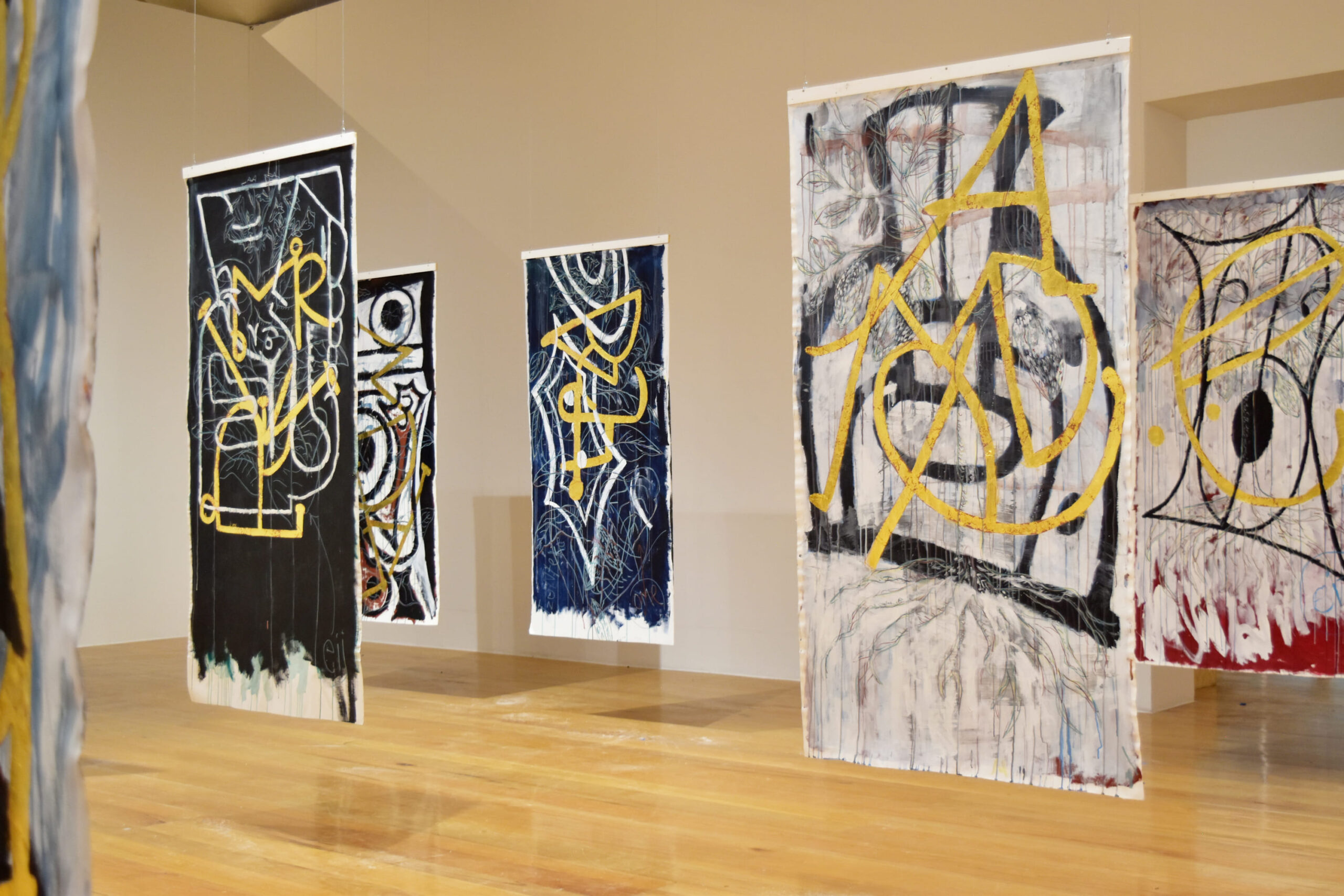
For the exhibition, the artist presents paintings, drawings and a sculpture. The paintings of one of his series, made up of seven works, have the quality of being double-sided, where on one side the artist represents everyday scenes of the pre-Hispanic era referring to the figures of the codices, such as agriculture and fishing, while on the other contains a gestural and abstract composition where he mixes white, black and sienna acrylic paint, the latter reminiscent of the pigments used in pre-Columbian murals. With 22 carat gold leaf, the artist traces the shape of a letter: T, S, E, R, which were used to mark the slaves in the novo-Hispanic period. Gold leaf was a material used in the altarpieces of the baroque churches of that period, a nod to the arrival of the Catholic religion in Mexico as part of the colonization.
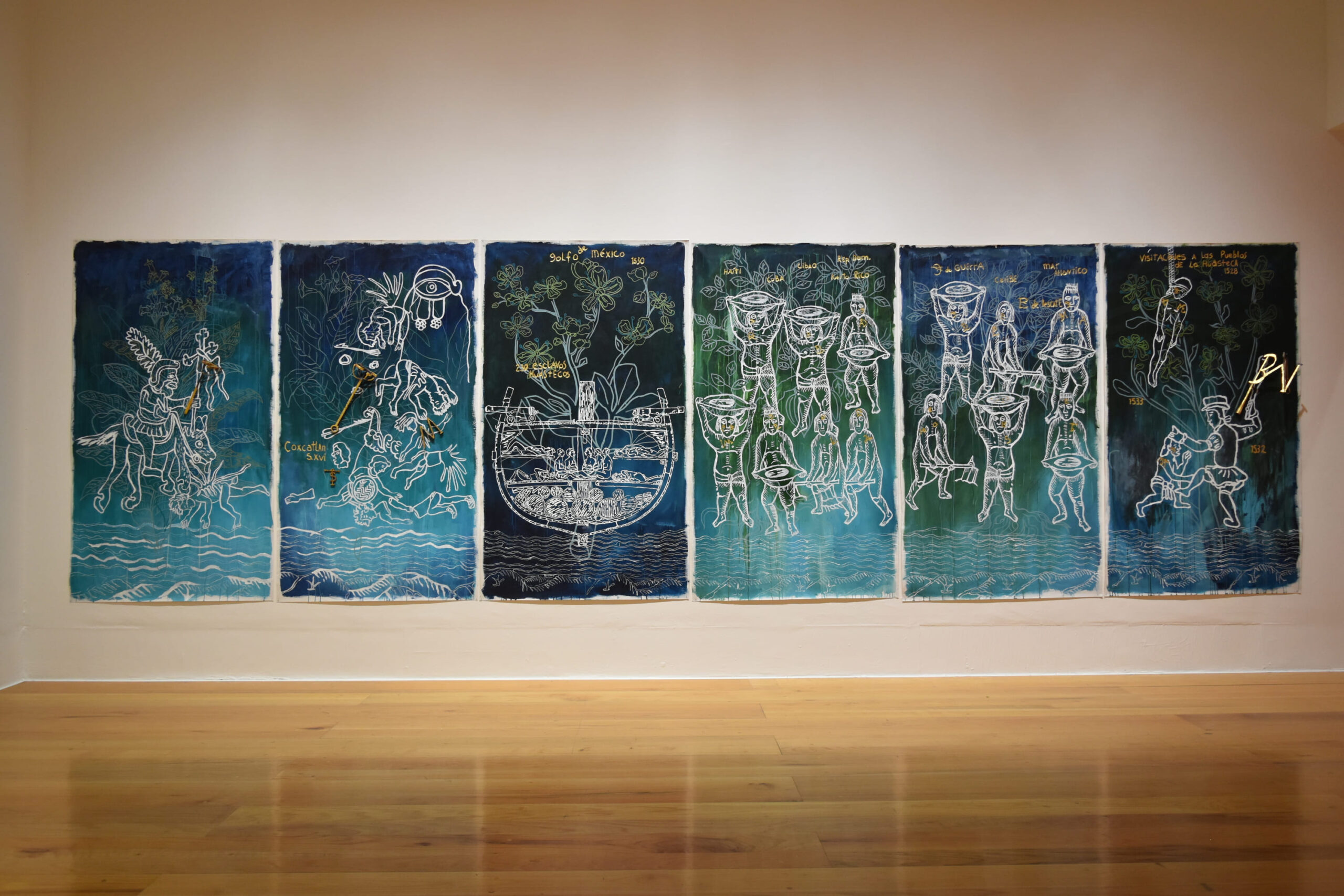
The second series is shown in the form of a screen, recalling the works of Novo-Hispanic times, especially the one depicting the fall of Tenochtitlán. The destruction of the Pánuco, which belongs to the Huasteca region where the artist is from, is poorly documented; therefore, in this series of works placed as a screen, Martínez undertakes a speculative history, which at the same time disputes the territory of memory, recollection and narratives, by creating images of how that episode could have happened. The image of the ship is documented in an 18th century engraving that explains how the African slaves arrived in New Orleans; from there Martinez takes up the same reference. The images are inscribed with the names of Coscatlán and Calmecayo, communities where his relatives lived, and also include metal elements with the initials of the owners of the Pánuco. In the background, the images have drawn rudas and tobacco leaves, as a way of protecting the action of evoking a history as dark as the slavery that his ancestors lived through.
The blood spilled in mythical and historical scenes captured in emblematic works of art is practically decontextualized through a conceptual exercise by artist Artemio, whose career has been distinguished by breaking with tradition.
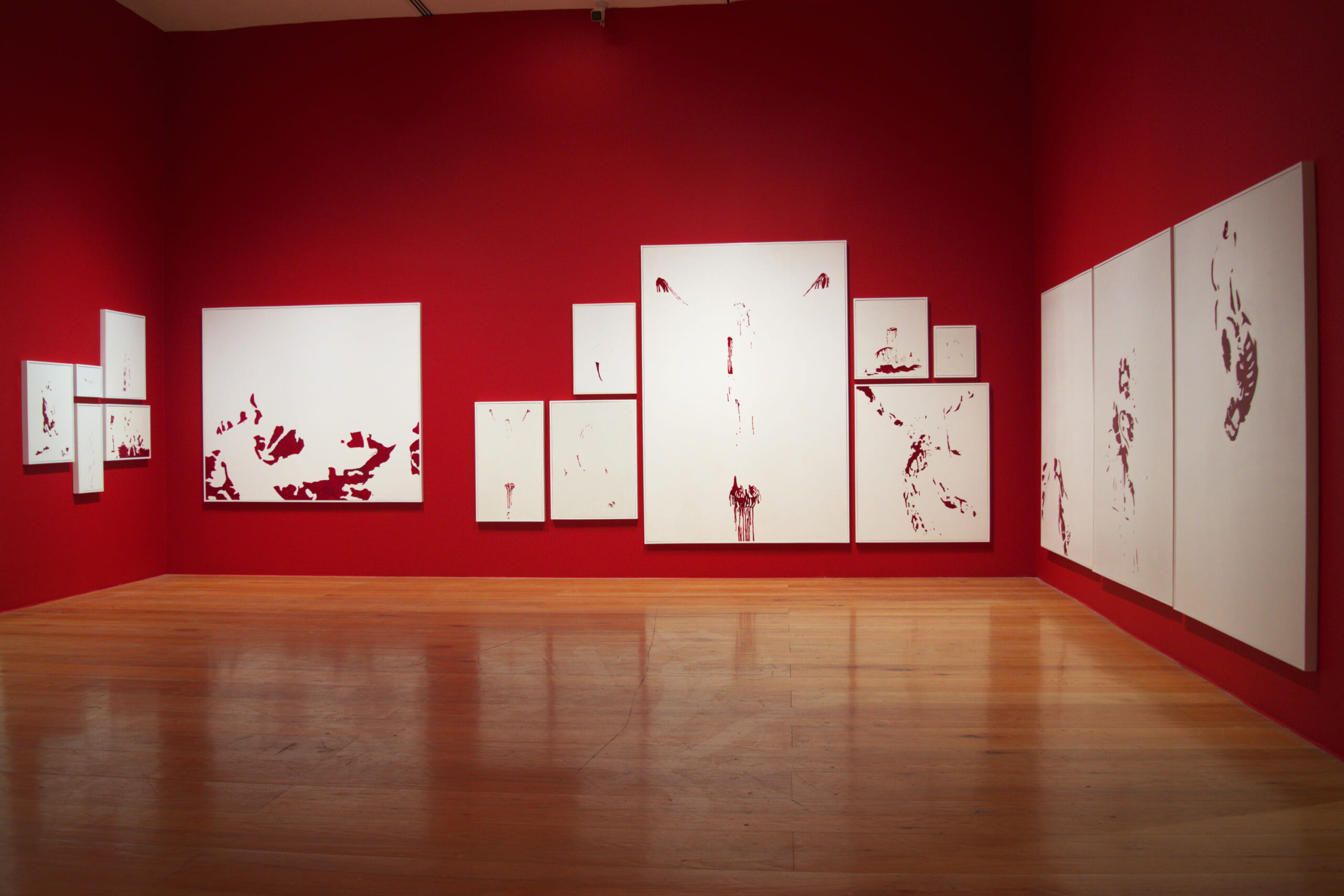
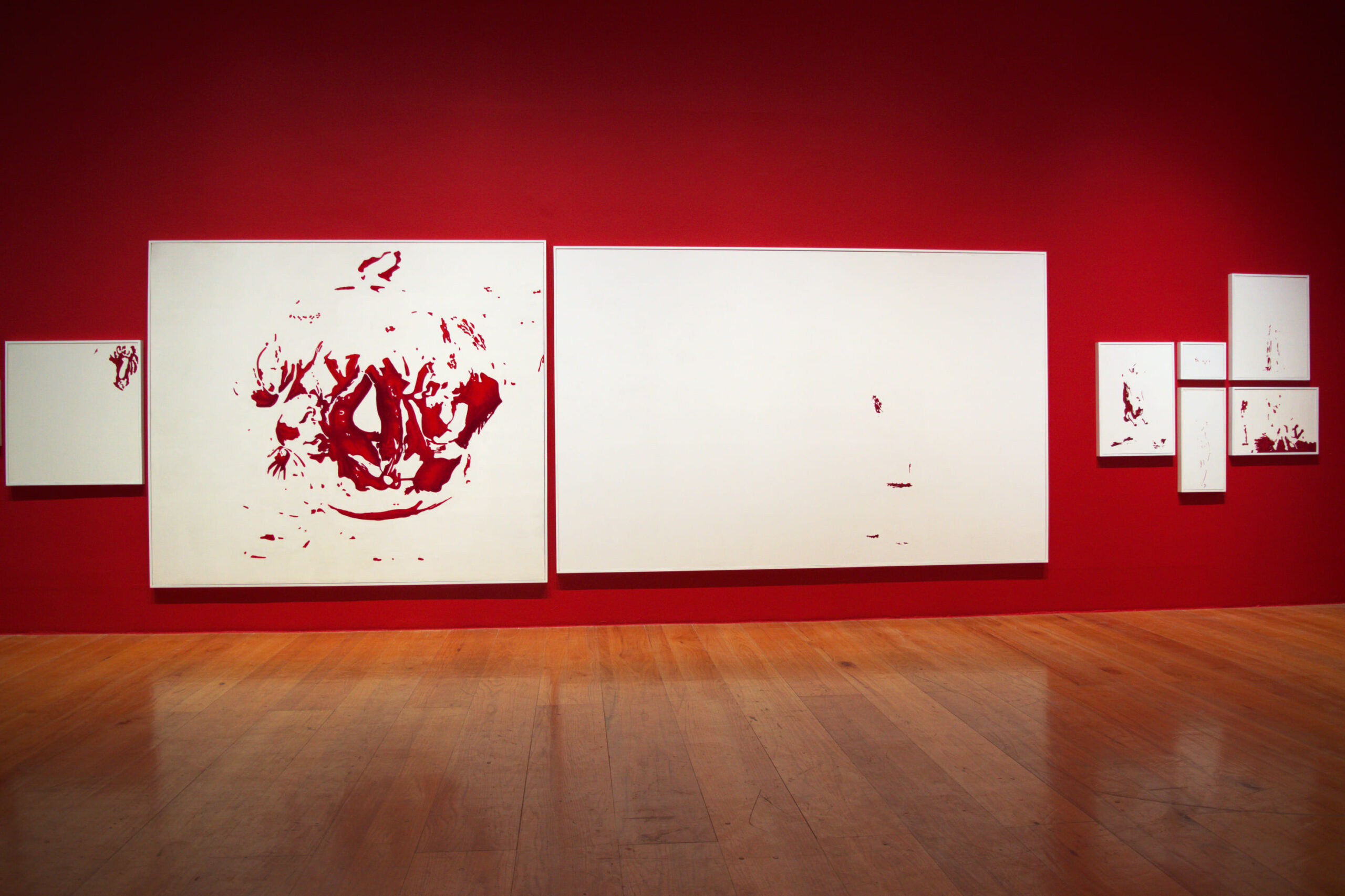
In his new production, the visual artist extracts the color red from the paintings where great masters of painting, such as Caravaggio, Velázquez or Kahlo, represented the vital liquid tissue for human functioning whose name gives title to his work: Blood.
Artemio uses the same dimensions as the original painting, in some of them the viewer could establish a connection with the original reference, although in others it is practically unrecognizable. It can be a biblical episode or from Greek mythology, as well as a sacred image or a war conflict. Some may contain numerous red stains, while in others the red is almost imperceptible, almost an imperfection in the immaculate white canvas.
What might be awakened in the viewer when confronted with these paintings? Ixel Rión points out in the room text that historically blood has been associated with opposing issues: the sacred and the profane; innocence and evil, life and death. With this new series exhibited at the Museo Aparo in Puebla, the artist reviews not only the history of universal art, but also how human beings have faced violence throughout the centuries. In a context as complex as the Mexican one, Artemio’s work becomes forceful in the face of diverse social problems, although this is not the artist’s initial intention.
Throughout all its definitions, the concept of harmony always maintains a characteristic unity. Whether in the harmony of a thought, the frequency of a transmission, or even the melody that identifies the beginning of a television program, this concept can only be in motion and connection. From three different perspectives, and through various media, this collective exhibition presents us with a vision of the state of contemporary painting in the 21st century.
Unstable frequencies presents the paintings of artist Ana Segovia, who, by disrupting mythical scenes from Mexican Golden Age cinema and Westerns, invites us to question the hegemonic model of heteronormativity. On the other hand, Noé Martínez conceptualizes the current relationship with the pre-Hispanic world and how this influences processes of identity vindication, claiming the survival of different cultural traits, forms of government, and social organization. This approach is carried out through references to Huasteca culture and its enslaved past, a narrative that has been little addressed or even overlooked in our visual history. Finally, Artemio breaks away from the inherited tradition of Western painting, eliminating iconography and classical scenes from universal art history. Instead, he creates pictorial skeletons that relate to his predecessors solely through the appearance of blood, showing us, through this violence, the relationships that arise in power structures.
All of them make up our harmony, constituting a powerful example of the pictorial front in Mexico, where elements from the past invite us to rethink our present.
Taiyana Pimentel